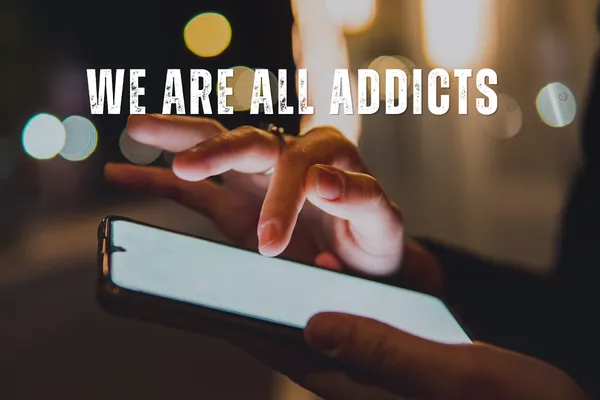
We Are All Addicts
I was the hard addict.
Crack cocaine. Alcohol. The kind of addiction that lands you in a cell, destroys every relationship you have, and leaves you detoxing in a concrete box wondering how your best thinking delivered you to the worst place imaginable.
I'm not guessing about addiction. I'm not theorizing. I lived it — from the inside of the disease and from thirty years on the other side of it.
And here's what those thirty years taught me that no rehab program ever will:
The line between the hard addict and the "normal" person is a lie.
You look at the guy nodding off on a park bench and think: that's not me. You look at the woman hiding vodka in a water bottle at 10:00 AM and think: I'd never. You draw a clean line between their life and yours.
That line doesn't exist.
The Same Disease
The mechanism inside a heroin addict and the mechanism inside someone scrolling Instagram for two hours is identical.
Not similar. Identical.
The need to attach to something that delivers temporary pleasure in order to avoid contact with yourself. The compulsive reach for a substance — chemical or digital — that numbs, distracts, or generates just enough stimulation to keep the inner silence from surfacing.
That's the disease. Not the substance. The movement.
The substance just determines the speed and severity of the damage.
A speedball will wreck your health faster, destroy your relationships sooner, and generate peripheral crime along the way. The destruction is loud and visible.
Scrolling will drain your glands, generate chronic anxiety, steal your time, erode your attention, and quietly hollow you out — but nobody stages an intervention for it. Nobody loses custody over it. Nobody hits "rock bottom" from it in any way the world recognizes.
That's the only real difference: volume, not nature.
The internal movement is the same. The persona is doing the same thing. Reaching for something external to avoid something internal.
And every human being on the planet is running some version of it.
Hard and Soft
Hard addictions are easy to spot.
Drugs. Alcohol. Gambling. The damage is visible. The behavior is undeniable. Society has names for it, programs for it, institutions built around it.
Soft addictions are invisible — which makes them more dangerous in some ways.
Scrolling. Shopping. Snacking. Binge-watching. Over-working. Over-exercising. Cleaning. Planning. Gossiping. Complaining. Codependency in relationships — staying enmeshed with another person to avoid facing yourself alone. Even "spiritual seeking" can become a soft addiction — consuming content about transformation without ever transforming.
Soft addictions don't look like addictions. They look like habits. Preferences. Lifestyle choices. Nobody calls you an addict for checking your phone 200 times a day. Nobody holds a mirror up when you eat past fullness for the third night in a row. Nobody questions the four hours of Netflix because "everyone does it."
That's the cover.
And the person running the soft addiction is usually the first one to point at the hard addict and say: at least I'm not like that.
That comparison is survival kung fu. The persona protecting itself from an honest look by finding someone worse off to stand next to. But the moment you elevate yourself above any of them, you've guaranteed you won't look at your own version — because you've convinced yourself you don't have one.
Different checkout lanes. Same store.
What You're Actually Running From
The reach is never about the substance. It's about what the substance covers.
Most people say "the silence" — and that's close. But it's not precise enough.
What's actually underneath the compulsion is layered. And if you've read the Shen Life piece on the practice of sitting, you already know the stages:
First — irritable discontent. The restless, prickly agitation that surfaces the moment stimulation stops. The organism protesting because it's been trained to move, fix, and escape. That itch is the first thing every addict — soft or hard — is running from.
Then — emotional residue. The grief you packed away. The anger you swallowed. The shame you built your personality around. The accumulation of everything you were too busy, too numb, or too afraid to feel. It surfaces the moment you stop reaching.
Then — the conditioning itself. Stored in the fascia. Locked in the tissues. The body's record of every unresolved event, clenched into posture, tension, and chronic holding patterns. This is where the addiction lives somatically — not in the mind, not in the "habit." In the body. In the physical architecture of avoidance.
And underneath all of that — the void. The emptiness the persona can't tolerate. The gap where Shen should be audible but isn't — because the signal is buried under decades of noise, compulsion, and running.
Every addiction — hard or soft — is an attempt to avoid making contact with one or more of those layers. The substance or behavior is just the vehicle. The destination is always the same: anywhere but here.
The Energetic Cost
In energy economics terms, every compulsive reach is an unauthorized withdrawal.
Not a chosen expenditure — an automatic one. The pattern fires, the organism reaches, and energy leaves the account before the conscious mind even registers what happened.
Phone in the hand. Fridge door open. Browser tab opened. Argument started. Purchase made.
You didn't choose it. The pattern did. And the pattern doesn't care about your balance.
Do this a hundred times a day — which most people do when you count the micro-reaches — and you wonder why you're depleted by evening. Why your attention is scattered. Why your creative output is flat. Why your relationships feel thin.
It's not a mystery. It's math. Your energetic account has been drained by withdrawals you never authorized, funding an avoidance program you never consciously chose.
But the cost goes deeper than daily energy.
Over time, compulsive reaching degrades the nervous system. The glands — particularly the adrenals and the pineal — get taxed from the constant stimulation cycle. The fascia hardens around the chronic tension patterns that the addiction both creates and feeds. The meridians stagnate. The organism ages faster — not from time, but from the relentless energetic drain of a system that never stops reaching and never fully rests.
That's the real price of addiction. Not the substance damage — the systemic degradation of an organism that was designed to heal, regenerate, and radiate, but can't — because all its resources are being spent on escape.
Why Willpower Doesn't Work
Most recovery models are built on willpower: resist the urge, manage the craving, white-knuckle through the withdrawal.
That works for a while. Sometimes a long while. But willpower is the mind fighting the body — and the body always wins eventually.
Because the addiction isn't in the mind. It's in the nervous system. It's in the fascia. It's in the survival-pathic wiring that learned, long before you had language for it, that reaching outward was safer than feeling inward.
You can't think your way out of a pattern that lives in the tissue. You can't willpower your way past a craving that's wired into the nervous system at a level below conscious thought.
This is why people relapse. Not because they're weak. Because the approach was aimed at the wrong layer. They were fighting the behavior while the body — the actual site of the addiction — remained untouched.
What Fills the Void
Here's the part no recovery model talks about — and it's the only part that actually resolves the equation.
The void underneath every addiction isn't empty. It just feels that way because the connection has been severed.
What belongs in that space — what the organism is actually starving for — is Shen. Contact with your own deepest nature. The living intelligence that built your body, keeps your heart beating, and knows how to heal what the persona broke.
When that contact is restored — not as a concept, not as a belief, but as a felt, somatic, bio-energetic event — something changes at the root level.
The SoluShen — the inner elixir that descends from the upper glands through the heart and spreads through the body — is the substance the organism was always reaching for. Every external substance, every compulsive behavior, every soft addiction was a counterfeit version of what the system actually needs: the internal medicine that dissolves patterns, restores coherence, and produces a satisfaction no external hit can match.
That satisfaction is bliss. Not the recreational kind. The kind that arises when a system reconnects to its source and the healing current flows again.
The addict isn't broken. The addict is disconnected — and reaching for substitutes because the real thing was never offered as an option.
Shen Life offers the real thing.
The Practice: Catch the Reach
You can start right now. Not with a program. Not with a pledge. With one move.
Catch the reach.
The moment you notice the hand moving toward the phone, the fridge, the scroll, the purchase, the argument — freeze.
Don't suppress it. Don't shame it. Don't white-knuckle through it.
Name it. "That's a reach."
Locate the feeling underneath it. Drop attention into the body. What are you avoiding? Where is the discomfort — gut, chest, throat? What layer is it — the itch, the emotion, the conditioning, the void?
Stay with the feeling for thirty seconds. Not the story. The sensation. Breathe into the exact location. Let it exist without being managed, numbed, or narrated.
Then choose. Not from compulsion — from clarity. If you still want the thing after thirty seconds of honest contact with what's underneath, take it consciously. If the charge has dropped — and it usually does — let the reach dissolve on its own.
That's not recovery. That's sovereignty. The practice of governing the reach instead of being governed by it.
Do it once today. Then again tomorrow. Then build from there.
Not to be "sober." To be free.
The Honest Ground Floor
Recovery — from any addiction, soft or hard — starts in the same place.
With brutal honesty.
The willingness to look at your own patterns — not someone else's — and say: I do this too. I'm running from the same thing. The only difference is the vehicle I chose.
I earned the right to say that in a prison cell. You don't have to go that far. You just have to stop pretending the line between you and the addict on the park bench is real.
Same disease. Different drug. Same human.
The void is real. The reaching is real. And the Medicine that fills both is real — waiting underneath every compulsion you've ever had, in the silence you've spent your whole life avoiding.
Reach for that instead.
Reach for it.

