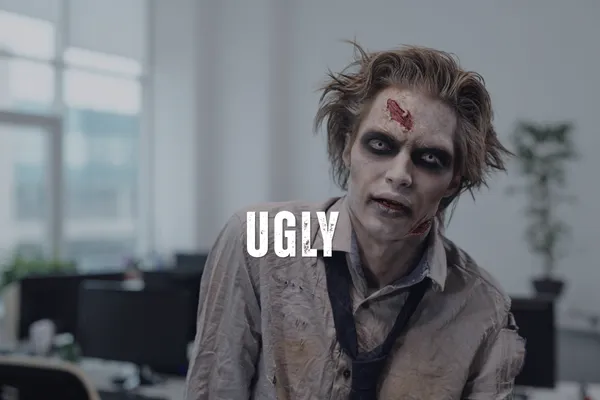
Ugly
You've never seen an ugly child.
Think about it. You've seen goofy-looking kids. Awkward kids. Kids with big ears or missing teeth or a head slightly too large for their body.
But ugly? No.
Children have a quality — a cherub-like luminosity — that has nothing to do with symmetry or features. It's a radiance. An openness. Something alive behind the face that makes every small child beautiful in a way that adults rarely are.
Then something happens.
They grow up.
And by the time they're middle-aged, a lot of them look like the life has been wrung out of them. Hardened. Contracted. Worn in a way that has nothing to do with mileage and everything to do with what's been accumulating underneath.
That's not aging.
That's ugliness — built from the inside out.
What Happened
As a child, the persona hasn't fully formed yet. The survival kung fu is still rudimentary. The patterns are shallow. The organism is mostly open, mostly connected, mostly radiant — because there hasn't been enough conditioning yet to shut it down.
Then adolescence hits. The sense of self sharpens. The persona begins to solidify — built almost entirely on survival-pathic conditioning. Fear. Anger. Shame. The desperate need to belong, perform, and protect.
Each of these creates a way of thinking, feeling, and behaving that writes itself into the body. Not just the mind — the fascia, the musculature, the nervous system, the posture, the face.
Over decades, these patterns compound. It looks ghoulish. Layer on layer. Contraction on contraction. The organism that once looked like a cherub begins to look like the sum total of everything it never dealt with.
The eyes harden. The mouth tightens. The brow furrows into a permanent crease. The body curls forward as if bracing for impact — because it has been bracing for impact for thirty years.
That's not genetics. That's the persona sculpting the flesh from the inside out.
Written Into the Body
Most people think the process is merely a part of aging — a biological process of gravity, genetics, and experiences. Time doing what time does.
That's the surface story.
The deeper story is somatic. Every bump and bruise of life — every unresolved conflict, every swallowed rage, every grief that never got metabolized, every fear that hardened into a permanent posture — leaves a deposit in the body.
Not metaphorically. Physically.
These deposits stagnate the meridians — the bio-energetic pathways that feed every system in the body. When the meridians stagnate, the systems they serve begin to break down. Digestion slows. Immunity weakens. Hormones drift. Circulation diminishes. Tissue dries. Joints lock.
The body doesn't just age. It contracts around what it never processed.
The heart hardens like a rock — burdened by decades of accumulated patterns, survival conditioning, unresolved pain. And the body contracts around it like a fist clenching tighter and tighter.
The hunchback. The curled shoulders. The locked jaw. The shallow breath. The dried-out skin. The stiffness that most people accept as "just getting older." Think of a star in a zombie flick.
It's not just getting older. It's the organism calcifying around everything it refused to feel.
The fist doesn't relax on its own. And the longer it clenches, the more the body reshapes itself around the grip — until the contraction becomes the posture, the posture becomes the identity, and the identity becomes the face the world sees.
Nothing New
This isn't a modern observation. The scriptures mapped it in physical terms thousands of years ago.
"Stiff-necked" — a people so contracted they can't turn toward what's true (Exodus 32:9).
"Hard-hearted" — the rock at the center of the fist, impervious to feeling (Ezekiel 3:7).
"Conscience seared with a hot iron" — inner knowing burned shut, cauterized until nothing gets through (1 Timothy 4:2).
"A sound heart is the life of the flesh: but envy the rottenness of the bones" — inner poison literally decaying the structure from within (Proverbs 14:30).
"A merry heart maketh a cheerful countenance: but by sorrow of the heart the spirit is broken" — the inner state writing itself directly onto the face (Proverbs 15:13).
Those aren't just spiritual metaphors. They're somatic descriptions. The ancients were body-reading the same condition this article names — a human organism hardened by its own unprocessed conditioning until the neck won't turn, the heart won't feel, the conscience won't register, the bones rot from the inside, and the face tells the whole story.
The Daoist and Chinese medical traditions mapped it even more precisely. The Five Emotions doctrine — foundational in Traditional Chinese Medicine — teaches that each excessive emotion damages a specific organ system: anger damages the liver, excessive joy scatters the heart, worry knots the spleen, grief constricts the lungs, fear depletes the kidneys. This isn't metaphor — it's diagnostic medicine. The meridian stagnation this article describes is the exact mechanism these emotions use to create disease. Every unprocessed feeling has an address in the body, and the body pays the rent whether you acknowledge the tenant or not.
The Disconnection
Here's the part that changes the conversation from cosmetic to spiritual.
Every layer of persona — every contraction, every survival pattern, every hardened emotional deposit — pushes you further from Shen. Further from Source. Further from the living intelligence that designed your body to heal, regenerate, and radiate.
If you were fully connected to Shen, you'd be connected to a perpetual state of healing. Not healing as a concept — as a bio-energetic event. The SoluShen — the inner cocktail that descends from the upper glands through the heart and spreads through the body — is the mechanism. It's the substance that dissolves patterns, regenerates tissue, and restores coherence.
That substance is bliss. Not bliss as a feeling you chase — bliss as the signature of a system that's connected to its source and healing in real time.
But the persona blocks the pipeline.
Every contraction constricts the channel. Every unresolved pattern creates another obstruction. Every layer of survival kung fu that hardens into identity is another wall between you and the Medicine that was designed to keep you alive, coherent, and — yes — beautiful.
The disconnection from Shen isn't just a spiritual problem. It's the root cause of degeneration.
The Evidence
And the evidence is everywhere — if you're willing to look.
Not just in the body. In the behavior.
Because the pain of disconnection is constant but unnamed, coping mechanisms fill the gap. Sarcasm is one of the biggest and most culturally accepted — a way to displace self-hatred onto others. A veiled insult disguised as humor. A way to externalize the poison that's been building inside, because if you can make someone else the target, you don't have to feel what's rotting underneath.
But it's not just sarcasm. It's cynicism. Bitterness. Chronic complaint. The slow, corrosive drip of a person who is in pain and has no tools to process it — so they leak it onto everyone around them.
And the face shows all of it.
You've seen it. The person whose features might be fine by any objective measure — but something behind the expression is sour. Hard. Closed. You can feel it before they say a word.
That's not a bad attitude. That's the visible evidence of an organism that has been clenching around its own unprocessed suffering for decades.
Ugly on the inside. Ugly on the outside.
The Reversal
So here's the question no one asks:
If ugly is built from the inside out — can beauty be restored from the inside out?
Yes.
Not cosmetic beauty. Not the manufactured kind. The kind that children have naturally — the radiance that comes from an open system connected to its source.
When the patterns release — through real inner work, through the TransformaShen fires, through the SoluShen dissolving what the persona cemented in place — the body responds. Not overnight. But undeniably.
The fascia softens. The posture opens. The breath deepens. The eyes clear. The face changes — not because of a procedure, but because what was underneath the contraction was always there. It was just buried under decades of survival.
This is why people who do deep, sustained inner work often look younger over time — not because they found a better skincare routine, but because they removed the thing that was aging them from the inside.
The fist relaxes. The rock dissolves. And what's left is the organism as it was designed to operate — open, coherent, connected, and radiating the signal it was always meant to carry.
Beautiful on the inside. Beautiful on the outside.
The Mirror
Look in the mirror.
Not at your features. At your expression. At the tone behind your face. At what your posture is saying about what you've been carrying.
That reflection is not your age.
It's your conditioning.
And conditioning can be changed. Not with affirmations. Not with a new wardrobe. Not with a facelift.
With the willingness to feel everything you've been clenched around — and let it go.
Reach for it.
References
Exodus 32:9 (KJV): "And the LORD said unto Moses, I have seen this people, and, behold, it is a stiffnecked people."
Ezekiel 3:7 (KJV): "But the house of Israel will not hearken unto thee; for they will not hearken unto me: for all the house of Israel are impudent and hardhearted."
1 Timothy 4:2 (KJV): "Speaking lies in hypocrisy; having their conscience seared with a hot iron."
Proverbs 14:30 (KJV): "A sound heart is the life of the flesh: but envy the rottenness of the bones."
Proverbs 15:13 (KJV): "A merry heart maketh a cheerful countenance: but by sorrow of the heart the spirit is broken."
Five Emotions Doctrine — Traditional Chinese Medicine. Foundational diagnostic framework mapping excessive emotions to organ damage: anger/liver, joy/heart, worry/spleen, grief/lungs, fear/kidneys.
Caraka Samhita — Foundational Ayurvedic text describing how psychic imbalances (rajasic and tamasic gunas) manifest as somatic disease.

