The Stake
There's a trick they use at the circus.
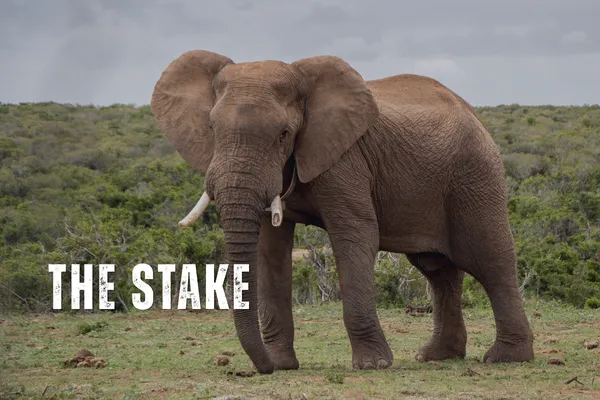
A full-grown elephant — tons of raw power, capable of uprooting trees and flipping vehicles — stands in an open field, held by nothing except a small rope around one ankle, tied to a wooden peg barely hammered into the ground.
No fence. No cage. No chains.
Just a rope the elephant could snap without breaking stride.
But the elephant never pulls it.
Because when that elephant was a baby — small, weak, and completely dependent — it was shackled with a heavy chain to an immovable steel stake driven deep into the ground. It pulled and tugged and fought with everything it had. And it couldn't move it. The chain was real. The stake was real. The baby elephant's nervous system recorded the verdict: this is stronger than me. Stop trying.
As the elephant grew — from hundreds of pounds to thousands — the trainers quietly swapped the heavy chain for a thin rope and the steel stake for a wooden peg. The restraint got weaker as the animal got stronger.
But the elephant never tested it again.
And now, decades later, an animal with more than enough power to walk free stays put — not because of the rope, but because of a story its nervous system wrote when it was too young to know the rules had changed.
That's not a circus trick. That's a blueprint.
The Story That Keeps You Small
The most powerful form of control isn't surveillance. It isn't fluoride in the water, EMFs in the air, or chemicals in the food.
It's a story.
A story about who you are — told to you before you had the capacity to question it.
You're limited. You're fallen. You're a sinner in need of saving. You're a consumer in need of products. You're a citizen in need of management. You're a body in need of medicine. You're a mind in need of education. You're a soul in need of a middleman between you and God.
Every institution — religious, political, educational, economic — has a version of this story. And every version has the same punchline:
You are not enough on your own. You need us.
That story is the stake. And most people never pull it out — not because they can't, but because their nervous system recorded the verdict so early and so deeply that the limitation feels like physics instead of conditioning.
The Three Boxes
When it comes to the deepest question a human being can ask — What am I? — most people are handed three options before they're old enough to evaluate any of them.
Box One: God is out there. Religion gives you a God who exists outside of you — above, beyond, separate. You worship. You obey. You follow the doctrine. And you never, under any circumstances, confuse yourself with the divine. That would be heresy. That would be dangerous. That would make you ungovernable.
Box Two: I don't know. Agnosticism gives you permission to shrug. Maybe there's something. Maybe there isn't. Either way, it's unknowable — so why bother reaching? This box looks like intellectual humility. It functions as a ceiling.
Box Three: There is no God. Atheism removes the question entirely. No God. No spirit. No deeper nature. Just biology, chemistry, and a finite ride on a spinning rock. This box looks like reason. It functions as a cage.
All three boxes share one thing in common: they keep you from the one conclusion that would change everything.
That you are the thing you've been told to worship, doubt, or deny.
Not as ego inflation. As lived realization.
And that realization — if it ever took root in a population — would be the most disruptive event in human history.
The Real Threat
Forget the comic book version for a moment — the Superman, the Dr. Manhattan, the idea that enlightened beings would walk around with supernatural powers that threaten the power structure.
Maybe that's real. Maybe the writers of those stories are expressing a fractal of something deep in the human psyche — an intuition that there's more available to this organism than anyone in charge wants you to access.
But you don't even need to go there.
You don't need anyone flying around or healing the sick with a touch. You don't need a single superhero.
You just need human beings who can see through bullshit.
Not from cynicism — from clarity. The ability to hear a narrative and feel whether it's true or whether it's being used to deceive. To see things as they actually are, not as they've been packaged. To doubt — not compulsively, but precisely — whatever doesn't match direct experience.
That's baseline enlightenment. Not levitation. Not cosmic consciousness. Just the refusal to be fooled — by others or by yourself.
And if that capacity spread overnight to eight billion people, the game would be over. Not because they'd storm the gates. Because the gates would become irrelevant. You can't govern people who see the mechanism. You can't sell a story to someone who reads the narrator.
That's why the stake stays in the ground.
History Is the Stake
The elephant's conditioning came from one failed attempt as a baby. Human conditioning comes from something more sophisticated: history.
Not history as "what happened." History as the curated narrative a culture tells itself about what happened — edited, framed, and repeated until it hardens into identity.
History tells you who your people are, what they're capable of, and what they should never attempt. It draws the boundaries of the possible. It defines the box. And once the box is internalized, the choices you make stay inside it — not because the walls are real, but because your nervous system says they are.
You have a wide array of choices available to you at any moment. But if your conditioning confines those choices to a tiny box, you won't reach outside it. You're afraid to. Or you've been conditioned to believe you're not capable. Or — most effective of all — you've been conditioned to believe the choices outside the box don't exist.
And if somehow you suspect they do exist? The story has a backup: those choices are dangerous. Forbidden. Satanic. Crazy. Irresponsible.
The box protects itself.
Pull the Stake
The elephant has more than enough power to walk free.
So do you.
The rope is a story. The stake is a memory. The field is wide open — and has been the entire time.
But you won't walk free by fighting the circus. You won't walk free by studying the stake. You won't walk free by building a philosophy about stakes and ropes and how unfair it all is.
You walk free by pulling the stake.
Which means: questioning the story your nervous system recorded before you were old enough to evaluate it. The story about what you are, what you're capable of, and what's allowed.
Not with cynicism. Not with conspiracy. Not with outrage.
With the quiet, sovereign clarity of an organism that finally looks down at the rope around its ankle and realizes — for the first time — that the only thing holding it there is a decision it made before it knew any better.
That's not rebellion.
That's waking up.
Reach for it.

