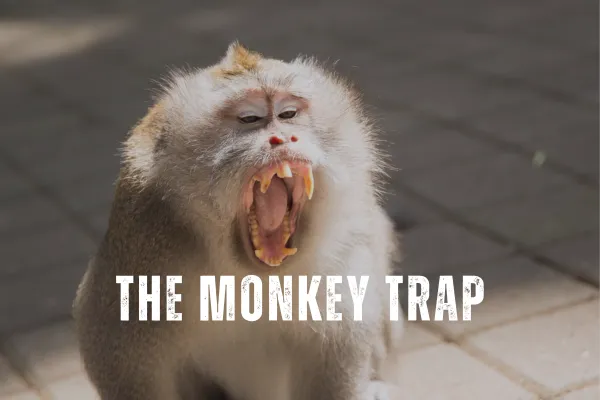
The Monkey Trap
It’s a big realization to accept the idea that: my life is the way it is because I am the way I am.
Not because you’re “bad.” Not because you’re cursed. Not because the world is conspiring against you.
Because you are running a consistent set of inner instructions.
The “way” is your way of thinking, feeling, and acting. Your defaults. Your reflexes. Your knee‑jerk reactions. Your habits. Your emotional posture. Your energetic signature.
Sit with that for a second.
The Mirror Doesn’t Lie
If your life is a mirror of your inner operating system, then the question becomes unavoidable: why not think, feel, and act in ways that reveal your full potential?
Why not generate thoughts and feelings of being capable, steady, and great—and then behave like someone who lives from those states?
In theory, it’s simple.
In practice, it’s not easy.
Because you don’t live from theory.
You live from patterns.
And patterns don’t care what you want. They care what kept you safe.
Why Patterns Win Under Pressure
Most people try to change their life by changing their ideas. They go straight to positive thinking. They try to “talk themselves” into a new identity.
Sometimes it works—briefly. Usually it doesn’t.
Because your life isn’t built on what you believe on a good day. Your life is built on what your nervous system does under pressure.
The deeper truth is this: we are conditioned to be the way we are by our ingrained patterns—psycho‑emotional‑physiological loops that shape our experience and identity. Over time, these loops become part of our persona. They become dominant themes in the psyche because they served a purpose, even if the purpose was dysfunctional.
A pattern might be controlling because chaos hurt you.
A pattern might be pleasing because rejection hurt you.
A pattern might be numbing because feeling too much hurt you.
A pattern might be dominating because being powerless hurt you.
The pattern isn’t “evil.”
It’s protective.
That’s why it’s hard to remove.
The Nervous System Clench
Here’s the part people don’t understand until they experience it: because patterns are linked to survival, any attempt to release them often triggers a defensive reaction.
You try to let go and the body tightens.
You try to soften and the mind panics.
You try to change and the old self shows up with a thousand reasons you shouldn’t.
It’s a clenching.
A contraction.
Like a fist closing tighter and tighter around a rock.
That contraction is not “you failing.”
It’s your nervous system doing what it learned to do.
The persona fights for its throne.
The Monkey Trap
There’s an old analogy that mirrors this dynamic perfectly.
In some primitive hunting methods, a trap is set for a monkey by hiding food in a narrow crevice—sometimes a rock pile, sometimes a coconut. The monkey can slide its relaxed hand into the hole easily. But once it clenches a fist around the food, the hand becomes too big to pull back out.
The escape is simple: relax the grip.
Let go.
Withdraw the open hand.
But that’s not what happens.
The monkey hangs on. It fights. It pitches a fit. It refuses to release the prize.
And in that refusal, it becomes trapped by its own grip.
The hunter doesn’t even need to chase it.
He simply walks up and clubs the monkey.
The tragedy isn’t the trap.
The tragedy is the grip.
Humans Do It, Too
Humans do the same thing—just with better vocabulary.
We hold onto familiar patterns as if our survival depends on them. We cling to control, to resentment, to being right, to the old story, to the old identity, to the old way of navigating pain.
And then we call it “who I am.”
But it’s not who you are.
It’s what you learned.
It’s what you grabbed when you were hungry for safety.
The pattern was a snack.
And now you’re treating it like it’s the only food that exists.
So you stay clenched.
You stay trapped.
You keep living the same life.
The Ceiling Of Success
Here’s the hard truth most people avoid: to transform into greatness, you have to release the patterns that got you to your current level of success.
Not because your current level is “bad.”
But because every level of development is built on a set of strategies—and eventually those strategies become ceilings.
The same pattern that once protected you becomes the thing that limits you.
At some point, you don’t need another coping mechanism.
You need a new operating system.
And you cannot install that new operating system by merely thinking different thoughts.
Positive thinking is often just the persona trying to put a motivational poster over a structural crack.
It looks better.
It’s still cracked.
What Actually Removes Patterns?
So what actually removes patterns?
In Shen Life language, patterns don’t disappear because you scold them, analyze them, or pretend they aren’t there.
They release when a deeper power comes online.
This is why willpower alone usually fails. Willpower is a part of the persona arguing with another part of the persona.
You don’t win freedom by fighting yourself harder.
You win freedom by awakening what’s deeper than the fight.
This is where the TransformaShen comes in.
TransformaShen Fire and The SoluShen Wash
The TransformaShen is inner alchemy. It’s the ignition of a deeper electro‑chemical force that melts the old grip.
When that fire awakens, something changes in the system. The body stops clenching the rock like it’s life or death. The mind stops defending every old story. The emotional field stops looping the same response.
And from that ignition, a refinement begins.
In Shen Life, we describe this refinement as the activation of higher centers in the brain and body that release a biochemical “wash” we call the SoluShen—a cohering, clarifying current that helps dissolve what’s false and reorganize you around what’s true.
Don’t get lost in the terminology.
Here’s the point: there is a state where you are no longer trapped by your grip.
And that state is not created by wishful thinking.
It’s created by transformation.
Open The Hand
So if you want to become great, don’t start by trying to “be great.”
Start by noticing where you are clenched.
Where are you holding on as if you’ll die if you let go?
Where are you gripping a story, a persona, a habit, a defense, a reaction?
Where are you calling a pattern “me”?
Because that’s the rock.
And that’s the hand.
And the first act of greatness is not domination.
It’s release.
Reach for ii!

