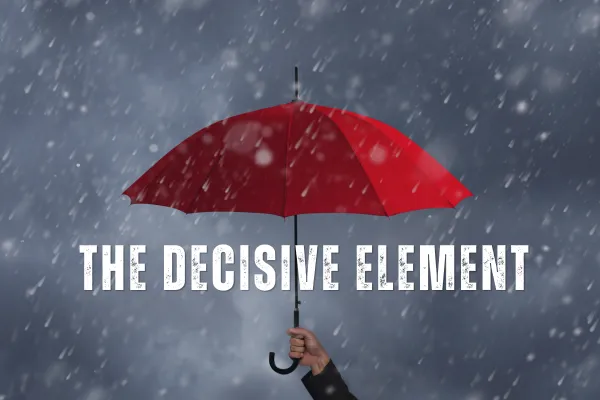
The Decisive Element
There's a quote from Dr. Haim G. Ginott — a psychologist and educator who wrote Teacher and Child in 1972
[1]. It's often misattributed to Goethe, and the original was written about the classroom. But strip out the setting and what remains is a universal truth about every human being in every room:
"I have come to the frightening conclusion that I am the decisive element.
It is my personal approach that creates the climate.
It is my daily mood that makes the weather.
I possess tremendous power to make a life miserable or joyous.
I can be a tool of torture or an instrument of inspiration.
I can humiliate or humor, hurt or heal.
In all situations, it is my response that decides whether a crisis will be escalated or de-escalated, and a person humanized or de-humanized.
And though it's often paired with a line from Goethe [2]:
"If we treat people as they ought to be, we help them become what they are capable of becoming"
The pairing is natural. Both point to the same responsibility.
Read that again. Slowly.
Not as inspiration. As a diagnosis.
The Frightening Part
Notice the word he chose: frightening.
Not empowering. Not exciting. Not liberating.
Frightening.
Because once you accept this — truly accept it, not as a quote you post but as a lived reality — you can no longer blame the room.
Not the economy. Not the boss. Not the spouse. Not the government. Not the culture. Not the weather — the actual weather or the metaphorical kind.
You are the weather.
Your mood. Your tone. Your posture. Your energy. Your presence — or your absence of it. These are the elements that set the temperature in every room you enter, every conversation you have, every relationship you maintain.
That's not a motivational poster. That's a terrifying amount of responsibility.
And most people would rather not carry it.
You Are the Climate
Think about the last room you walked into.
Not what happened in the room. What you brought to it.
Were you present — or performing? Grounded — or scattered? Open — or armored? Were you bringing Shen into the space — or dragging your survival machinery behind you like a weather front?
Because everyone in that room felt it. Maybe not consciously. But their nervous systems registered your signal the moment you arrived. Bodies are tuned to read other bodies. Before a word is spoken, the room already knows what kind of weather just walked in.
A regulated nervous system calms the room. A dysregulated one agitates it. A person operating from Shen creates space for others to settle. A person operating from survival creates pressure for others to react.
You've felt this. You know the difference between walking into a room where someone is anchored and walking into one where someone is spinning. The first feels like shelter. The second feels like a storm you didn't sign up for.
That's the climate. And you're creating one — whether you know it or not.
Tool of Torture or Instrument of Inspiration
Here's where the quote gets surgical.
You possess tremendous power. Not the power to control outcomes — the power to shape experience. The experience of every person you interact with today.
A word lands differently depending on the state it's delivered from. The same sentence — said from presence — heals. Said from reactivity — wounds. Said from contempt — destroys something that might take years to rebuild.
You can humiliate or humor. Hurt or heal. Escalate or de-escalate. Humanize or de-humanize.
And the variable isn't the words. It's you. Your state. Your inner weather at the moment of contact.
This is why Shen Life doesn't start with communication skills, conflict resolution techniques, or relationship frameworks. Those are surface tools. The real lever is deeper:
Who are you being when you open your mouth?
If the answer is "my survival machinery" — the charmer, the controller, the avoider, the reactor — then the best communication technique in the world is just a nicer delivery system for the same old weather.
If the answer is Shen — present, regulated, clear — the technique almost doesn't matter. The signal carries the message before the words arrive.
The Projector in the Room
You already know the Shen Life model: your body is the projector, life is the screen.
This quote adds a layer most people miss: you're also the projector for everyone else's screen.
Your state doesn't just shape your reality. It shapes the field around you. Your children absorb your weather. Your partner navigates your climate. Your coworkers calibrate to your signal. Strangers in the checkout line feel the pressure drop when you walk up agitated — or feel something settle when you arrive grounded.
You are broadcasting all the time.
The question isn't whether you're affecting the room. You are. Always.
The question is: what are you broadcasting?
The Response Is the Decision
In all situations, the quote says, it is my response that decides.
Not the situation. Not the other person's behavior. Not the provocation. Not the injustice.
My response.
That's the decisive element. Not what happened — but what I did with what happened.
A crisis can be escalated or de-escalated. A person can be humanized or de-humanized. And the fulcrum isn't the crisis or the person — it's me. My state. My sovereignty. My ability to hold the tension without collapsing into reactivity.
This is where survival kung fu gets exposed in real time. The reactive move — the snap, the jab, the withdrawal, the passive aggression — feels justified. It feels like strength. But it escalates. It de-humanizes. It adds weather to a room that was already storming.
The sovereign move — the pause, the breath, the response chosen from Shen instead of fired from survival — de-escalates. It holds space. It treats the person in front of you as someone capable of more — even when they're showing you their worst.
That's not weakness. That's the hardest kind of power there is.
Treat People as They Ought to Be
The last line of the quote is the one most people skip:
"If we treat people as they ought to be… we help them become what they are capable of becoming."
That's not naive optimism. That's creative physics.
When you treat someone according to the survival version of them — the persona, the pattern, the worst thing they just did — you reinforce that version. You lock them into the cage they're already in. Your signal says: this is who you are.
When you treat someone according to what they're capable of — not what they've been, but what Shen in them could become — you create a different field. You hold a signal that says: I see something in you that you haven't seen yet.
That signal doesn't guarantee they'll change. But it gives them something most people never receive: someone who refused to reduce them to their worst moment.
That's what a Shen-led human does in a room. Not fix people. Not save them. Refuse to reduce them.
The Daily Audit
So here's the practice.
At the end of today, review your interactions. Not what other people did — what weather you brought.
Did I escalate or de-escalate?
Did I humanize or de-humanize?
Was I an instrument of inspiration — or a tool of something less?
Not as guilt. As honest inventory. The same way you'd audit your energy account or run the fill-in-the-blank question.
Because if you are the decisive element — and you are — then the most important work you can do today isn't on your goals, your career, or your spiritual practice.
It's on the climate you carry into every room.
Reach for it.
References
Ginott, Haim G. Teacher and Child: A Book for Parents and Teachers. New York: Macmillan, 1972. p. 13. https://quoteinvestigator.com/2018/10/08/decisive/
Goethe, Johann Wolfgang von. Wilhelm Meister's Apprenticeship. (1795–96). Paraphrased: "If we treat people as they ought to be, we help them become what they are capable of becoming."

